
_ES
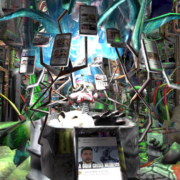
SI-4202 is designed as a workshop-laboratory aimed at introducing XR technologies—and, in particular, Mixed Reality—to a diverse audience, promoting open, accessible and practical engagement with these emerging tools. Through a pedagogical and experiential approach, the workshop offers a guided journey through the various stages involved in developing an immersive and interactive artwork. From initial conceptualisation through to final production and experimentation. To this end, the immersive and interactive projects by the artist Carles Castaño Oliveros and the production company Servicios Inmersivos will serve as reference points.
Far from presenting these technologies as exclusive or highly specialised fields, the workshop aims to demystify them through the use of accessible software and resources that do not require advanced technical knowledge. The learning process is structured from a participatory and playful perspective, encouraging exploration, creativity and experimentation as fundamental drivers for understanding and engaging with Mixed Reality.
Free activity. No registration required
Recommended for ages 15 and over
Escuela de Comercio
Friday May 1
17:00 – 19:00 h.
2 hours
Spanish
Actividad organizada por Arenas Movedizas en colaboración con LEV Festival
_FR
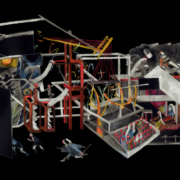
Ito Meikyu is a virtual reality experience built around references from Japanese art and literary history (Fukinuki Yatai, The Tale of Genji, The Pillow Book) and unfolds as a vast sensory fresco with strong emotional potential.
Ito Meikyu presents a heterogeneous collection of drawn, animated and sound scenes, which are taken from the digital material. In a way, it recreates a subjective world in the form of a labyrinth composed of fractal architectures, inhabited by plants, objects, animals, men, women, patterns and calligraphy. It functions like a virtual game of hide-and-seek that audiences can explore freely, guided by the chance of their discoveries.
Starting from his work as a draftsman, Boris Labbé’s practice is characterized by the combination of digital motion-image techniques with those specific to animated cinema. This approach forms an original and vibrant language that questions the relationships between painting and cinema, music and dance, the body and animals, plants and minerals. Labbé creates cinema without direct shooting, actors, characters, or dialogue, offering a narrative open to audience interpretation. Collages and references to art, literature, and philosophy have become essential resources in his audiovisual language.
Ito Meikyu was awarded the Grand Prix – Venice Immersive at the 81st edition of the Venice International Film Festival.
Escuela de Comercio
Thursday, April 30
to Sunday, May 3
11:00 – 14:00 h.
16:00 – 21:00 h.
20’
no dialogue
MINIMUM AGE 12 YEARS
Credits:
Written and directed by Boris Labbé.
Produced by Ron Dyens, Gilles Chanial.
Original music and sound design: Daniele Ghisi.
Lead Developer: Charles Ayats.
Developer: Elle Buglione.
Artists: Germain Linder, Capucine Latrasse, Ryo Orikasa, Boris Labbé, Agathe Sollier, Collin Gallego, Beatriz Ruthes dos Santos, Manu Batot.
Sound: Daniele Ghisi, Alex Nogueira
Actividad organizada por Arenas Movedizas en colaboración con L.E.V. Festival
_ES
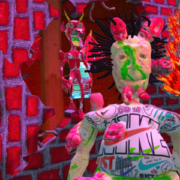
Following his participation in the latest edition of LEV Matadero, Carles Castaño Oliveiros presents *****2025/…, a mixed reality experience produced by Servicios Inmersivos that challenges the public with a critical view of contemporary society.
The piece immerses participants in a dystopian environment where, through interactive tours—such as searching for a room to rent in a cardboard city or performing procedures in clandestine operating rooms—the cracks of a world caught in capitalism and overconsumption are exposed.
During the immersion, they must make decisions that affect both individual experience and social destiny. With a strong narrative and political charge, *****2025/… transforms the space into a speculative fiction that reflects, with irony, the contradictions of today’s society, creating a space for reflection on the present and possible futures.
Carles Castaño (Girona, 1992) is a digital creator specialized in real-time 3D art, with a background in programming, illustration, and visual arts. He has exhibited his work in festivals and institutions such as Arts Santa Mònica, Grec, IDEAL, Bombas Gens, MIRA, or Hyper House. He currently directs Immersive Services, a hybrid space that bridges the gap between a production company and an artistic laboratory, developing immersive and collaborative XR projects in dialogue with institutions such as the Generalitat de Catalunya and the Barcelona City Council.
Escuela de Comercio
Thursday, April 30
to Sunday, May 3
11:00 – 14:00 h.
16:00 – 21:00 h.
Varies. Approx 50’
Spanish and English
MINIMUM RECOMMENDED AGE 16 YEARS
Credits:
Original idea, Direction, Art & 3D: Carles Castaño Oliveros.
Developer: Adrián Puig Arto.
Art & Assistant Director: Sau-Ching Wong.
Soundscape & Musical composition: Juan Cristóbal Saavedra.
3D Modeling: Vertebra studios.
Executive Production: Servicios Inmersivos.
A co-production with Hyper House.
Actividad organizada por Arenas Movedizas en colaboración con L.E.V. Festival
_ES
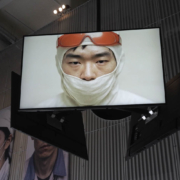
Near-perfect precision. No hesitation, no fatigue, no loss of focus. Industrial robots embody the mastery of automation. A logic born on the assembly lines of Taylorism that today, hand in hand with artificial intelligence, spilled far beyond the factory floor— into our thinking, our judgement and our memory. Philosopher Bernard Stiegler called it La Société Automatique: every area of existence merged into an invisible network of calculations, with technology quietly shaping our lives from the inside.
Félix Luque Sánchez’s exhibition La Sociedad Automática gives form to that unease: a universe of machines that never falter, never tire, never revolt. Mechanical Sisyphuses locked in purposeless loops, mirroring a present where the human is no longer at the centre. A dystopian present that raises an urgent question: can we still reclaim the technology that governs us?
The work of Felix Luque Sánchez in collaboration with Damien Gernay, Vincent Evrard and Iñigo Bilbao, explores how humans conceive their relationship with technology and provide spaces for reflection on current issues such as the development of artificial intelligence and automatism. Using electronic and digital systems of representation, as well as mechatronic sculptures, generative sound scores, live data feeds and algorithmic processes, he creates narratives in which fiction blends with reality, suggesting possible scenarios of a near future and confronting the viewer with her fears and expectations about what machines can do.
LABoral Centro de Arte
Abril 17 – October 17
Opening:
April 17th, 7:00 pm.
Tuesday to Thursday
10:00 am. to 7:30 pm.
Friday, May 1
6:00 pm. to 9:00 pm.
Saturday, May 2
11:00 am. to 8:30pm.
A co-production by LABoral Centro de Arte y Creación Industrial, iMAL, Art Center for Digital Cultures & Technology, Europalia and the Wallonia-Brussels Federation
_FR
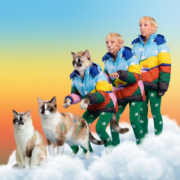
Anne Horel is a French artist, filmmaker and digital collagist whose work explores the intersection of mythology, digital culture and artificial intelligence. Working across film, installation and moving images, she develops speculative narratives that examine how technology reshapes perception, identity and collective imagination.
Rooted in collage, both analog and generative, her practice treats AI as a contemporary extension of surrealist montage: a space where personal memory, popular culture and collective subconscious merge.
In February 2026, her short film La Tisseuse d’Ombres received the Best Use of AI Award at the Artefact AI Film Festival, marking a new phase in her practice toward cinematic storytelling.
LA SEÑAL ESTÁ ABIERTA is a vertical video installation conceived as a visual spell activated within the architecture of the Capilla de San Esteban. Designed specifically for the sacred spatial context, the work transforms the chapel into a catalyst for collective intention.
Combining surreal collage imagery, mythological hybrids, and cosmic symbolism, the piece unfolds as a contemporary incantation, an invitation to awaken perception and reconnect with a shared sense of presence.
Rather than referencing religion, the work draws from universal archetypes, astrology, and hermetic symbolism to propose a poetic space of reflection. Through image, sound, and rhythm, LA SEÑAL ESTÁ ABIERTA sends a message of peace, harmony, love, and interconnected consciousness, imagining the possibility of a radically different world shaped by awareness and collective empathy.
Capilla de San Esteban del Mar
Thursday, April 30
to Sunday, May 3
11:00 – 21:00 h

_ES
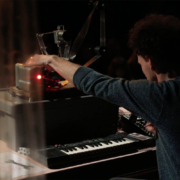
Enrique del Castillo will present Umbráfono on the incomparable stage of the Iglesia de la Laboral, which has reopened to the public following six years of restoration works. Europe’s largest elliptical dome will provide the setting for a unique sound experience.
Starting in 2018, the Umbráfono Project investigates the possibilities of generating sound through image and light, using a 35mm film, using machines and optical reading systems designed and built by the artist himself.
This line of research has earned him notable recognition, including the first international PowSOLO Sound art Award in 2020. His work has also been exhibited and performed internationally, from the 25 FPS Festival in Zagreb to Cafe OTO in London, as well as at institutions such as MACBA, Matadero Madrid, and the Centro de Creación Contemporánea de Andalucía (C3A).
As a graphic artist and musician with a multidisciplinary background, the work of Enrique del Castillo (Jaén, 1982) lies at the intersection of visual art and experimental music. He holds a Fine Arts degree from the University of Granada, Master’s in Artistic Production and Research from the University of Barcelona, and classical training at the Ramón Garay Professional Conservatory of Music (Jaén). His visual practice has developed alongside sound art, with more recent forays into the fields of performing arts and film.
Umbráfono will be performed in two shows.
_DE
Studio Sven Sauer’s installations focus on a theme that increasingly challenges our times: hope—not as an idealized state, but as a real, verifiable trace. Hope is considered a remnant of a bygone era, an abstract symbol. We are too surrounded by noise, disillusionment, and cynicism, amid all the clamor and images that bombard us every day.
Studio Sven Sauer searches for these hidden traces of hope in our reality. Their works are the result of extensive research, data, statistics, and scientific studies collected over decades.
For hope, as his work suggests, is not a sentimental feeling, but a measurable phenomenon. It flickers in data series, in ecological forecasts, in social fractures, and in the quiet perseverance of people and systems.
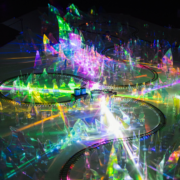
Deviation spreads out across the room as a carpet of glass fragments, woven from shards collected from all over the world. In our society, broken glass symbolizes something ominous. Broken windows precede earthquakes. Shards are broken during riots when anger thunders against shop windows. And there is glass that is deliberately broken to stop people. Shards of glass on the tops of walls. Sharp-edged borders.
But are we really as dark as we perceive ourselves to be? Based on texts by historian Rutger Bergman, the installation reveals another truth: in times of great hopelessness, history shows cooperation prevails. From certain angles, the processed shards catch light and divide it a hundredfold, turning fragments of destruction into reflections of hope.
Colegiata del Palacio
de Revillagigedo
Thursday, April 30
to Sunday, May 3
11:00 – 21:00 h
Credits:
Artwork „Deviation“: Studio Sven Sauer
Train modification: @helldorfer_engineering
Electronics: Lukas Esser
Creative coding: @bruno.ammon
Production: @nsevvalg / @martinhussain
Music: @theatre_of_delays
Texts and studies: @RutgerBregman
Clips: @frank_sauer
_CH
Under the name Cod.Act, André and Michel Décosterd bring together their respective practices. André as a musician, Michel as a visual artist. Together they create performances and interactive installations based on the interplay of sound and movement. Since 1999, they have developed lean and functional devices at the intersection of the mechanical and the organic.
These devices are not the artwork itself, but the medium through which encoded musical structures come to life. Activated either by the audience or by the artists themselves, the works generate ever-changing configurations, random, ephemeral and multidimensional, offering a different experience with each activation.
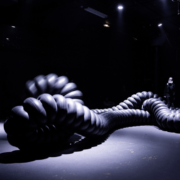
πTon is an intriguing sound installation: a rubber tube, closed in on itself, twists and undulates like an invertebrate organism. Surrounded by silent figures equipped with loudspeakers, it appears to struggle in vain to escape. Its movements fuel a polyphonic ritual, both primitive and sophisticated, composed entirely of artificial voices. Drawing on raw matter and natural physical phenomena, the work merges organic movement and vocal expression into a striking sonic and visual event.
Tickets must be collected in advance from the box office at the Teatro Jovellanos. A maximum of two tickets per person may be collected for any of the same-day performances.
Please arrive 10 minutes before the start of the event. If tickets are sold out but there are still seats available, admission will be on a first-come, first-served basis.
Teatro Jovellanos box office opening hours:
Thursday, April 30: 12:00 – 14:00 | 17:30 – 22:30
Friday, May 1: 12:00 – 14:00 | 16:00 – 20:30
Saturday, May 2: 12:00 – 14:00 | 16:00 – 20:30


_FR
Eric Vernhes’ practice is based on the creation of “temporal objects”, moving devices that harmonize with the viewer’s consciousness, creating a relationship of sympathy and synchronicity. His work aims to expand our awareness of ourselves, our bodies, the world and time, questioning our relationship to reality, fiction and otherness.
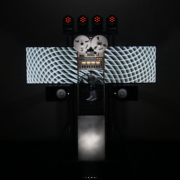
Meeting Philip is a musical, video and sculptural work built around the recording of the conference given by Philip K. Dick in 1977 in Metz. During this intervention, Philip K. Dick revealed that one of his favorite themes, the existence of a plurality of parallel universes, was indeed a reality and not a fiction. For him, there was no doubt that our world was the result of a computer program whose designer (God, programmer reprogrammer), episodically changed variables in the past, which disrupted the unfolding of our present time and gave birth to other uchronic and divergent universes. The feelings of “déjà vu” would result directly from this “reprogramming”.
In Meeting Philip the artist does not answer the question of the credibility of K. Dick’s story, but rather considers that this question is irrelevant. Confronted with the many facets of K. Dick’s personality, his wanderings and his flashes of brilliance, he takes the side of the writer against the self-proclaimed prophet. The latter (who has never convinced anyone) is ultimately only the tool of the former (who is recognized as brilliant).
Credits:
Co-produced by Videoformes and the CNRS
Centro de Cultura
Antiguo Instituto
Thursday, April 30
to Sunday, May 24
12 – 14 h. / 16:30 – 20:30 h.
Schedules from May 4 to May 24
Monday to Friday:
17.30 – 20.30 h.
Saturdays:
12 – 14 h. / 17.30 – 20.30 h.
Sundays:
12 – 14 h.